
Choosing Rope. What type of rope should I use?
If rope bondage is new to you, start off with inexpensive Nylon or MFPMFPMultifilament polypropylene, a synthetic rope made from many fine plastic strands twisted or braided together. It is prized for bright, saturated colour, a soft hand, and the fact that it can be machine-washed, which suits it to wet play and settings where hygiene matters. Being slick, it holds knots less reliably than natural fibre and can cause friction burns if it runs fast across skin. at 1/4" (6mm). They are soft and sensuous, and come in lots of colors if you like colored rope. Once you know that you are in to rope bondage, you might want to invest in a set of nice natural fiber ropes, HempHempA natural bast-fibre rope spun from the stalk of the hemp plant, valued for its strength, grip, and body. Coarser and heavier than jute but more durable, it is a common choice for suspension once properly conditioned. Like all natural fibre it must be inspected for wear and kept dry, since damp and rot weaken it out of sight. & JuteJuteA natural fiber rope commonly used in traditional shibari, known for its grip and aesthetic qualities. are favorites of many riggersRiggerThe person who ties in rope bondage, also known as the top or dominant partner.Types of Participants - More Vocabulary Terms.
Buying through links on this page helps support TheDuchy!
We have affiliate relationships with Twisted Monk, Agreeable Agony, TwistedSyn, Amazon and other vendors we link to and get a small percentage of your purchase as a referral bonus.
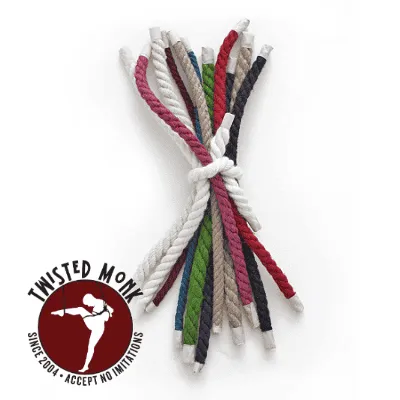
- Twisted Monk is great source for high quality Hemp, Jute and POSH.
- Agreeable Agony is a great source for MFP.
- TwistedSyn is a great source for Nylon, Cotton and UV Reactive rope that will glow in blacklight!
For guidance on common thicknesses and lengths, check out: Rope Lengths & Thicknesses.
Buy quality rope &
help support TheDuchy!
We have affiliate relationships with:
Twisted Monk
Agreeable Agony
TwistedSyn
... and others
If you buy through our links, we get a small percentage of your purchase as a referral bonus!
What type of rope should you use?
What type of rope is best for you?
It depends on what you want to use it for. Here are some qualities of different kinds of ropes so you can decide for yourself based on your needs.
Here are a few commonly-used types for comparison. Each is 1/4" (6mm).
Note the different appearances of the different types. Natural v synthetic fiber, braided vs twisted, twisted one way vs the other. There are many options.
Some people use Cotton or Nylon for their first ropes as the are inexpensive and easy to find. If you do this, avoid "solid core" versions. They don't flatten as much under tension and don't respond properly to various commonly used knots, lock-offsLock-offA finishing move that secures the working end of the rope so the tension already built into a tie stays put and the wraps don't loosen. Lock-offs come in many forms, from a simple half hitch to a purpose-made friction, and are used to hold a structure steady before moving on to the next stage.Handling - Locking Off and frictionsFrictionA method of securing rope without knots, using wraps and tension to hold rope in place.Bamboo Suspension FrictionFrictionsFrictions for Hard Points. That said, I do like Solid-Core Cotton Sash CordCotton sash cordA soft, braided cotton rope, the same hardware-store cord once used for window sashes, that is inexpensive, easy to find, and gentle on skin. Its low cost and comfort make it a popular choice for practising knots and low-stakes floor ties. It is not suited to suspension: cotton is weaker and less predictable under heavy load than jute or hemp, and it tends to jam when cinched tight. for making floggers. You will see it used extensively in Flogger Forge.
"Natural Fiber" Ropes:
These include:
Hemp, Jute, Sisal, Cotton, Coconut, BambooBambooA rigid natural pole used in rope work as a spreader or hard point, central to Japanese bamboo bondage, or takezao (竹竿, literally "bamboo pole"). The pole holds limbs apart and organises lines, and in suspension it can act as the frame a body hangs from. Because a cracked or under-strength pole can fail without warning, the bamboo must be sound and its load capacity checked before use.Bamboo Bondage
- Pro: Better friction or “tooth”, so it grabs better and takes fewer knots to hold securely
- Pro: It doesn't stretch as much and has more consistent stretch characteristics.
- Con: Doesn't take dye as well. Colors will be more muted, less brilliant and it will take more dye to get a rich color.
- Con: More expensive
Qualities:
- Hemp and Jute are very popular with riggers world-wide.
- Hemp is stronger and can be used in suspensionSuspensionA rope technique where the bottom is lifted completely off the ground, supported entirely by rope.Suspension.
- Jute is typically lighter and moves in a nice springy way and is popular for floor work.
- Sisal can certainly be used for floor work but be prepared for rope burnsRope burnA friction injury to the skin caused by rope dragging across it quickly, ranging from a red mark to a raw graze. It usually happens when rope is pulled through too fast while tying or during an uncontrolled release, and is largely avoided by feeding rope smoothly rather than yanking it; minor cases are cared for like any other abrasion, by cleaning and protecting the area.Rope Burn.
- Coconut rope is even more nasty. It is used when rope burns and discomfort from the rope itself is actually part of the plan for the sceneSceneA single, bounded session of rope or BDSM play, with a clear beginning and end that partners step into and out of together. Its shape and edges are set during negotiation, and once a scene winds down, aftercare begins. A general BDSM concept rather than something specific to rope.Finding the Local "Scene" or "Community"Overview. Most rope bottomsRope BottomThe person being tied in rope bondage, also known as the bottom or submissive partner.Types of Participants - More Vocabulary Terms just stop struggling altogether after a little time in coconut rope...
"Synthetic Fiber" Ropes:
For floor work (non-suspension), these include:
Most synthetic ropes from a hardware store, including the type of nylon they usually carry (which is often solid-core), "mixed fiber" rope, & poly-pro. Also parachute cord.
- Pro: Less expensive
- Pro: Nylon, MFP and ParacordParacordA thin, lightweight braided nylon cord, originally parachute suspension line, built as an outer sheath around several inner strands. Its small diameter makes it handy for decorative detail, small bundling, and gear, but it is far too narrow to spread load safely over the body and is not used for suspension. As a thin cord it can bite and concentrate pressure, so it is kept away from anything weight-bearing. come in many brilliant colors
- Con: Poly pro or mixed material does not take color well/consistently with regular dyes
- Con: Some types can stretch in inconsistent/unpredictable ways.
For Suspension:
AmsteelAmsteelA brand of rope made from ultra-high-molecular-weight polyethylene (UHMWPE), an exceptionally strong, light, low-stretch synthetic line. Its high strength-to-weight ratio suits it to uplines, hardware connections, and other rigging elements rather than ties against the body, where its thin, slippery profile would cut and bind. It is treated as structural line, inspected and rated like the rest of the hard rigging., POSH, MFP (multi-fiber propylene), Nylon (types curated by suppliers for use in bondage, not the types typically found in hardware stores), Hempex
- All the Pros from above
- Pro: Good choices for suspension up lines as they are much stronger than natural fiber ropes of the same thickness.
- Can be purchased in a wide variety of colors, but do not take dye well at home.
Rope Construction
Rope can be constructed in a number of common ways. Here are a few examples:
- (A) Paracord - Braided nylon sheath over twisted nylon thread making up the core
- (B) Cotton Clothes Line - Braided cotton sheath over twisted cotton thread making up the core
- (C) Hemp Rope - Twisted strands, see next panel for more details
- (D) Cotton sash cord - Braided cotton sheath over twisted nylon thread making up the core
Whether you pick braided or twisted rope is a personal preference, but they do behave and look different. Twisted Rope has more bumps in it which tends to increases the friction and make knots hold a little better, but braided rope with good tooth will hold just fine as well. Either is fine, but most riggers don't like to mix the types in a single scene, the stylistic differences can look jarring...
Twisted Rope Components
Many people love "traditional" rope--that is, "twisted strand" rope--made of natural fibers.
- (A) A twisted strand rope...
- (B) is made up of 3-5 Strands (3 is the most common)
- (C) Strands are made up of yarns. (In this rope, I unlaid one strand to find it was composed of 4 yarns.)
- (D) Yarns are made of individual fibers.
Each layer is twisted in the opposite direction of the layer before. This interconnects all the fibers, allowing their internal friction to grip each other firmly to make a strong rope.
One of the reasons we talk about using the "hook" or the "scissors" technique to handle rope is that if you use your thumb and forefinger in a pincher-like movement to grab the rope, you might grab just one strand and not the whole rope. If you do that and pull, you can pull the strands apart, unlaying them in the middle of your rope--hyperthreading them-- and getting your rope all messed up. It is very difficult to get your rope back in order if it has been pulled apart like this and it will never be quite as strong.
Coloring or Dying Ropes:
If you love colored rope, nylon can be a good choice (pure nylon, not poly-blends with nylon, not poly-pro, poly doesn't accept dye).
Above:
- (A) Nylon (pure Nylon) - Accepts dye well. Easy to get bright or rich colors
- (B) Nylon/Poly-Pro - Nylon accepts dye, poly-pro doesn't accept it as well. You end with this mottled look
- (C) Hemp - Accepts dye, but the color is duller/more matte. To achieve a deep, rich color like this take much more dye than does nylon.
Nylon is nicely smooth and comfortable as well, but it has very low tooth, so you need to use surgeon's knots instead of square knotsSquare knotA binding knot that joins two ends by tying two opposing half knots, left over right and then right over left, so the finished knot lies flat. Known in Japanese as hon musubi (本結び, roughly 'true knot') and in English also as the reef knot. It holds a bundle together reliably but tends to slip when used to join two separate loaded ropes, so it is chosen with that limitation in mind.Square Knot | Surgeon's Knot and any half-hitch style knot should be done three times instead of two.
You can also by MFP that is pre-dyed. MFP is soft, yet has good tooth and holds knots well. It is also very strong and some riggers prefer it for suspension support/anchor lines.If you want to buy your own natural fiber rope and condition it yourself so that it is ready to use for bondage without being too prone to giving you or your partner rope burn, McVarij has a nice tutorial on what you need to do. Perhaps after doing this yourself once or twice, you will understand why bondage rope vendors charge what they do for bondage-ready rope! :)
Keep learning
Ready to go further with rope?
Members unlock the full library — every tutorial, scene breakdown, course, and flogger guide — plus offline downloads and the community.