
Washing rope
By Lazarus Redmayne
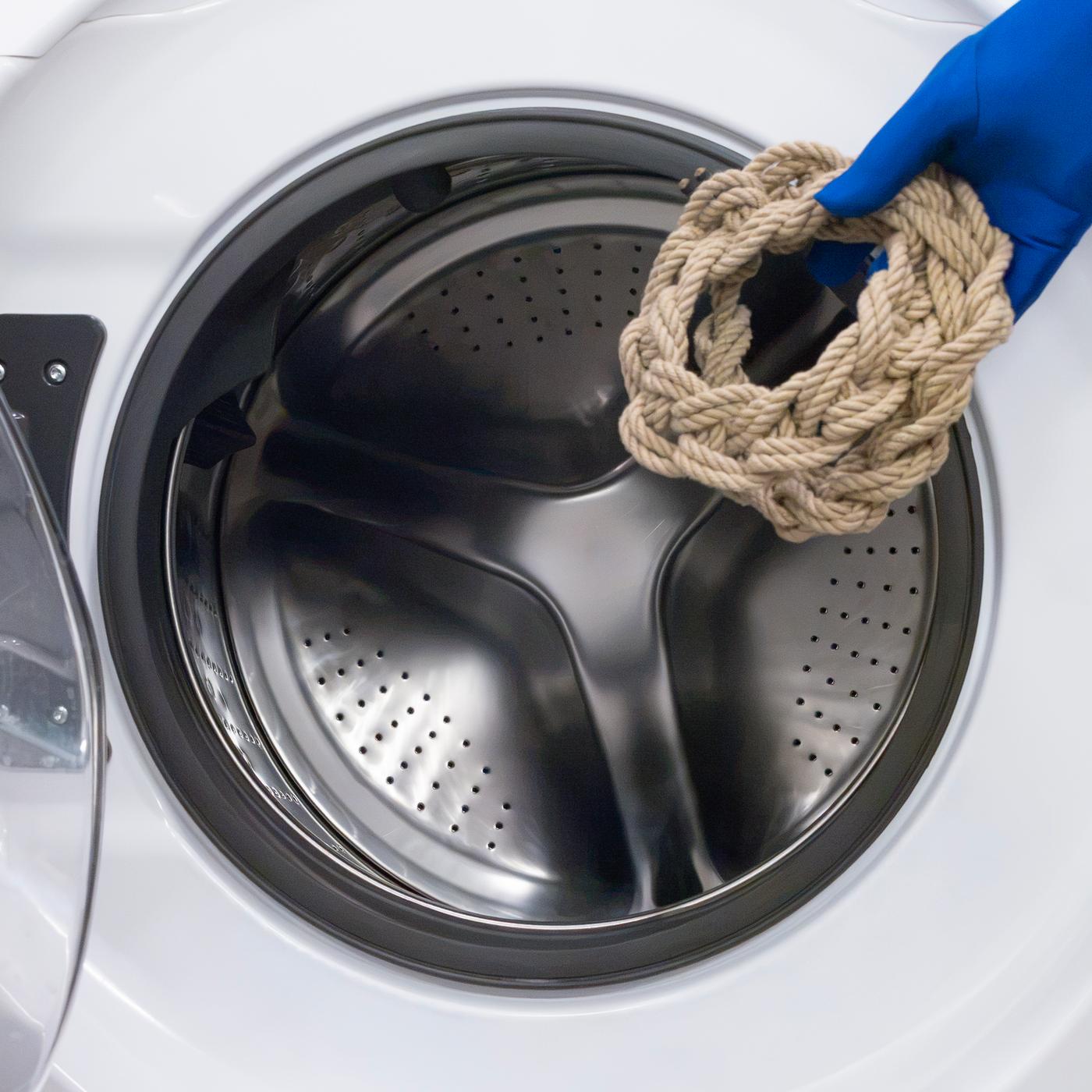
Washing Your Rope: Why, When and How
Eventually, most ropes should probably be washed. If, when and how depend heavily on what the rope is made from … and what happened to it.
At the time of this writing, Blue and I had recently gotten back from teaching at a major convention. We only ever bring synthetic fiber ropes to conventions. Fibers like posh, nylon, and MFP. Why?
Why wash rope?
- Hygiene
- Reducing wear
Hygiene
Rope gets personal. It absorbs sweat and skin oils, picks up dust from floors. And if you tie at parties or conventions, this problem is compounded. You may put down your own floor blanket or pad, but it is easy for rope to land on those floors anyway, and who knows what has transferred from people’s shoes onto those floors? Ropes may also put on several people at a single event, potentially adding that dimension as well.
So, washing your rope periodically can be helpful (for some types of rope). Washing can remove dirt, sweat, oils, odors and substances that may irritate the next person’s skin.
Important: Rope cannot be sanitized or fully disinfected.
You can clean it, but not sanitize it. If you have ever tried to dye rope, you learned that it is difficult to get dye to penetrate deeply into the rope. The same is true of cleansing agents. Soap and water can do a good job of cleaning the surface and perhaps just below the surface, but they cannot get to every microorganism that may be inside a rope.
This is true of all rope, but is even more of an issue with natural fiber rope which has even more fibers to absorb and hold on to contaminants.
Depending on how soiled the rope is, washing may not be enough. If the rope contacted blood, feces, vomit, genital fluids, an active skin infection or another significant contaminant, the safest option is to dedicate that rope so that it will only ever be used on that specific person (create a set of “Personal Rope”), or retire it entirely.
Reducing wear.
There is another reason to wash your rope: Particles worked into a rope can cause abrasion between its fibers, accelerating wear. (This is one reason cleaning and inspection are treated as maintenance issues in theatrical and industrial rigging.) So cleaning and re-oiling your rope will extend it’s useful life.
Plan ahead, make things easier
For events, consider bringing a washable synthetic set for general use and keeping natural-fiber ropes for demonstrations or established partners. Use separate, clearly marked rope for intimate areas, avoid transferring rope from genital or anal contact to the face or mouth, and discuss shared-rope practices as part of negotiation.
Before washing
First, what kind of rope do you have? A rope that looks like classic rope may be hemp or jute … or it may be spun polyester (POSH) or other synthetic options. Depending on what it is, it will react differently to being washed.
** Important: Do not use bleach, stain removers, solvents, degreasers or improvised disinfectants unless the rope manufacturer specifically approves them for that exact fiber. Chemical compatibility varies, and damage may not be immediately visible.
Inspect your rope. Should it be washed … or retired?
Inspect the rope before washing it. Look and feel for:
- Broken or frayed fibers, cuts, areas where the rope diameter thins
- Changes in the twist or lay
- Unusually soft sections
- Flat, hard, glazed or
- Discoloration that might indicate chemical exposure
Cleaning does not restore damaged rope. Rope with altered structure or an unknown history should not simply be washed and returned to service, especially in load-bearing applications like suspension.
If it is time to retire your rope due to it condition, maybe it can remain part of your scenes as a flogger!
Lylas Heavy Lashes
Tonyas Twisted Tongue
Zoe's Zipper-Slapper
Washing synthetics: Nylon, MFP, POSH, spun polyester, synthetic hemp, Hempex
Synthetic-fiber ropes are generally more tolerant of repeated washing and less likely to deform than natural fibers. For this reason, when I go to conventions and other shared-rope environments, I mostly use POSH, nylon or MFP.
If your manufacturer provided care instructions, use those. If not, this usually works well:
- (Optional, but very helpful) Loosely chain-stitch the rope (see below to see how, if needed). This is optional, but helps to avoid having to deal with a giant tangle!
- (Optional) Place it in a mesh laundry bag or tied pillowcase.
- Machine wash using cool water, the shortest gentle cycle, a small amount (½ tsp/2.5ml) of extremely gentle unscented detergent**(e.g. Woolight, Soak, Perwoll, Emal … something that is pH-neutral, enzyme-free) … Add an extra spin cycle if you washing machine has that feature.
- Your washer’s spin cycle should remove much of the water.
- Remove the rope from the chain stitch.
- (Optional) Put the rope under light tension. There are many ways to do this, see below for a few examples. Washing may shorten some synthetic ropes slightly; this helps combat that.
- Allow rope to air-dry completely in a ventilated area away from direct sunlight, radiators, hair dryers and other heat sources. It can be helpful to have a fan blowing over it.
- Inspect the entire length again before use.
- (Do not add oil)
Washing hemp or cotton
Hemp is generally more durable than jute, but it remains a natural fiber and can still swell, change texture or lose conditioning when washed. Some hemp ropes can tolerate a cold, delicate machine wash; others are hand-washing only. Follow the instructions supplied with your rope rather than assuming all hemp can be treated alike.
Machine method
(You can also wash it via the tub/bucket method discussed in Jute below.)
- (Optional, but very helpful) Loosely chain-stitch the rope (see below to see how, if needed). This is optional, but helps to avoid having to deal with a giant tangle!
- (Optional) Place it in a mesh laundry bag or tied pillowcase.
- Machine wash using cool water, the shortest gentle cycle, a small amount (½ tsp/2.5ml) of extremely gentle unscented detergent** (e.g. Woolight, Soak, Perwoll, Emal … something that is pH-neutral, enzyme-free). … Add an extra spin cycle if you washing machine has that feature.
- Your washer’s spin cycle should remove much of the water.
- Remove the rope from the chain stitch. (If it is still too wet and cannot be easily untied, just let it continue drying on it’s own for a day or two.)
- Put it into loose coils.
- Let it continue to dry, until it is barely damp (it may already be at this stage)
- Put the rope under light tension (there are many ways to do this, see below for a few examples).
- Allow it to air-dry completely in a ventilated area away from direct sunlight, radiators, hair dryers and other heat sources. This can take several days. It can be helpful to have a fan blowing over it.
- Inspect the entire length again before use.
- Re-oil (important for Hemp, not for Cotton). (See below for more, if needed)
Washing jute
Jute is the least forgiving of the common shibari ropes. Some people say you should never wash Jute. That is not true of all types, but as with all rope, follow any cleaning instructions that may be provided by the manufacturer.
When wet, Jute’s fibers curl, it swells, and gets shorter twist may tighten. Uneven washing or drying can leave it thicker, springier, misshapen or weakened. Washing also removes some of the oils or waxes used to improve its handling and resistance to abrasion. Routine washing should therefore be avoided. If you attend public events or conventions, consider using a more washable rope, keeping jute for known partners. For ordinary dust or light surface contamination, airing the rope and wiping it with a slightly damp cloth may be preferable. When washing is unavoidable, do not use a machine.
Bucket / Tub Method
- Fill a bucket or tub with cool water
- Stir in a small amount (½ tsp/2.5ml) of extremely gentle, unscented detergent** (e.g. Woolight, Soak, Perwoll, Emal … something that is pH-neutral, enzyme-free).
- Put your rope into a loose coil that will fit in the bucket.
- Submerge the rope.
- Gently agitate the rope in the water. Do not scrub the rope against itself.
- Let it soak for 20 minutes.
- Agitate gently again
- Rinse thoroughly with cool water until no soap remains. Perhaps in a second bucket.
- Hang in loose coils until it stops dripping
- Put the rope under light tension (there are many ways to do this, see below for a few examples).
- Allow it to air-dry completely in a ventilated area away from direct sunlight, radiators, hair dryers and other heat sources. This can take several days. It can be helpful to have a fan blowing over it.
- Inspect the entire length again before use.
- Re-oil (important for Jute). (See below for more, if needed)
Video
Video Contents:
- Why clean your rope? Natural vs synthetic fiber rope (0:08)
- Preparing your rope (chain stitching it) (0:52)
- Chain-stitching a long rope (2:28)
- Washing rope in a machine (4:30)
- Various ways to put rope under tension when drying it (4:49)
- If hemp or jute, oil your rope (6:58)
Chain-stitching a rope
This is what we will be doing. This helps prevent it from getting tangled while being washed.
Unbundle your rope and find the bight.
Hold the bight in the palm of your non-dominant hand.
Create a loop, laying the tail on top of itself.
Reach through the loop and hook the tail.
Pull a little of the tail through…
…to create a new small loop.
Reach through the new loop and hook the tail.
Pull a little of the tail through to create a new small loop.
Repeat…
…
Note that we are leaving each stitch quite loose so that soap and water can easily get to it.
Repeat creating stitch after stitch…
…
…
When you get close to the end…
…pull the tail all the way through...
…
Run the tail through the bight…
…like this.
Lock them together with a Half Hitch. To do this, run the tail under the bight…
…then around and under itself.
(Fun fact, this method of connecting ropes is called a ‘Sheet Bend’.)
Tighten it a little
This is ready to wash.
Chain-stitching a *long* rope
Unbundle your rope.
Bring the tails and bight together.
Place your finger between the tails and bight.
Run your finger between them just like when you are trying to find the primary bight.
When you find the new bight…
… treat this like your primary bight and do the same thing as above.
Create a loop.
Reach through the loop and hook the tail (four strands this time).
Pull a little of the tail through to create a new small loop.
Reach through the new loop and hook the tail.
Pull a little of the tail through to create a new small loop.
Repeat…
…
…
…
When you get close to the end…
…pull the tail all the way through.
Put your fingers into the bight, and feed the tail to those fingers.
Run the tail through the bight.
Lock them together with a Half Hitch.
Tighten it a little
You can coil the chain, if needed.
This is ready to wash.
Washing rope
Machine method:
Most ropes can be washed like this…
…but if the rope is delicate, you can put it into a laundry bag or old pillow case.
…
This can also help keep them from getting tangled if they come undone in the washing machine.
Wash on the gentlest cycle. Using a small amount (0.5 tsp / 2.5ml) of gentle, scent-free, pH-neutral detergent like Woolight, Soak, Perwoll, Emal, etc…
Set your washing machine to spin dry. Add a second spin dry if your machine has that feature.
Drying rope (dry it under tension, several methods)
There are lots of ways to put rope under tension. I will start with a classic closet method, then will show other options using a table or some stools.
This is what we will be creating
Here is one way to set up rope to dry in a closet
Ropes can get kinked ends if you use tight knots while drying, this is especially true of Jute.
…in fact, if you are using Jute, tie a piece of string or twine to the end of your Jute, the make all the connections I describe below using those extensions! This can be helpful for Hemp, too, but is much more important for Jute.
To limit this, let’s connect the end using a Clove Hitch (this is total optional, you can use Two Half-Hitches or other connection method, just don’t do so too close to the ends. Run the tail over the closet rod (or whatever)
Keep the tail moving around the rod in the same direction, but move it to the other side of the tail.
Keep going around the rod…
… until you get to the front. Tuck the end under that most recent wrap.
Hold the end, then…
…pull the tail to tighten the Clove Hitch.
Now run the tail down…
… to something with a bit of weight. You only need a few pounds. I am using a larger weight just because it has a convenient handle shape. Run the rope around the handle…
…up to and over the rod…
…and back down.
Continue until you are almost out of rope. You can tie off this end now if you like, but if you are drying more than one *synthetic* rope at once, you can connect them.
If hemp or jute, tie each off separately or use a separate string or twine to connect them so they don’t get kinked.
If synthetic (these ropes are POSH) you can connect them with a Surgeon’s Knot, but do so a few inches away from the end.
Continue wrapping until you are out of rope If the rope is near the rod or weight, you can lock it off with a Half Hitch. Run the tail around the ropes…
…then under itself.
Pull into the node to tighten.
This should hold fine while the rope dries. Again, this is POSH, so is very forgiving. If hemp or jute, use the extension string trick.
If the end of the rope is in the middle of the span, you can lock off with a few Half Hitches.
Allow to fully dry. Adding a fan can help.
Never store rope while it is damp. Allow it to dry completely, inspect it and then store it loosely in a clean, dry place away from sunlight and chemicals. A clean rope is useful; a clean, inspected and, if necessary, appropriately retired rope is safer.
Other ways to put rope under tension
Drying around a table
You can wrap it around a table. If your table is sensitive to moisture, protect it with some towels.
Drying between two stools
You can wrap it between two stools or chairs, keeping them separate in some way.
Oiling rope – Natural fiber only
Let’s do this Q&A style!
What kinds of rope need to be oiled or waxed?
- Hemp and jute benefit from being oiled or waxed.
- Do not oil or wax synthetic fiber ropes.
What kind of oil should I use to oil my ropes?
- It is important to use something that will not go rancid. Generally, avoid plant or animal-based oils.
- Baby oil and mineral oil are good choices.
- One plant-based option that some people like is Jojoba Oil. It is technically a liquid wax, and has a long shelf life, so it also works well.
- Bondage rope manufacturers also often sell specially-formulated rope oils that perform well
How do I oil my shibari rope?
- Put a small amount – like the size of a dime – in the palm of one hand.
- Rub it on your palms
- Run the rope through your hands a few times to add a very light coat of oil.
- That’s it.
- Coil the rope using your preferred method and it’s ready for us!